European farms often need machinery that can work efficiently in limited spaces without sacrificing traction, lifting ability or implement compatibility. This is particularly important for vineyards, orchards, horticultural farms, greenhouses and specialty-crop operations.
A Stage V compact tractor combines a smaller, manoeuvrable design with an engine developed to meet European emissions requirements. It gives farmers a practical option for working between narrow rows, managing implements and completing everyday agricultural tasks across different terrain and weather conditions.
What Does Stage V Mean for a Compact Tractor?
Stage V refers to European emissions requirements covering engines used in non-road mobile machinery. The rules establish limits for pollutants released by machinery engines, including particulate matter and nitrogen oxides.
Regulation (EU) 2016/1628 introduced emissions limits and engine type-approval requirements for different categories and power ranges of non-road machinery. Agricultural and forestry tractors fitted with applicable engines are also subject to Stage V pollutant-emissions requirements.
For farmers and machinery buyers, Stage V is therefore more than a model name. It indicates that the tractor’s engine has been designed for the emissions framework applied in European markets.
However, buyers should still confirm the complete documentation, type approval and registration requirements applicable in their country before purchasing or importing a tractor.
What Is a Compact Tractor?
A compact tractor is a smaller agricultural tractor created for work where a full-sized machine may be difficult to operate.
Its reduced dimensions can help the operator move through narrow crop rows, turn in restricted headlands and work around trees, buildings, fences and greenhouse structures.
Compact tractors are commonly used for:
- Vineyard and orchard maintenance
- Inter-row cultivation
- Spraying and crop protection
- Mowing and grass management
- Light soil preparation
- Trailer and material movement
- Estate and property maintenance
- Greenhouse and horticultural work
The right compact tractor should not be selected by size alone. Farmers must also examine engine power, transmission, four-wheel drive, hydraulic lifting capacity, PTO options, implement compatibility and operator safety.
Why Are Compact Tractors Suitable for European Farms?
European agriculture includes large commercial farms, but it also includes vineyards, orchards, small holdings, horticultural businesses and mixed farms with limited working space.
In France and Italy, a compact tractor may be used between vineyard rows. In Spain, it can support orchard and specialty-crop work. Farmers in wetter areas may value four-wheel-drive traction, while farms with uneven or sloping ground need stability and controlled manoeuvring.
A correctly selected tractor can help farmers perform several jobs with one power unit. Instead of purchasing separate machinery for mowing, cultivation and spraying, the farmer can connect suitable implements through the PTO and three-point linkage.
This versatility makes compact tractors useful not only during planting or harvesting periods but throughout the farming year.
Important Features to Check Before Buying
Engine power
Horsepower should match the intended workload rather than simply being as high as possible.
A 26 HP compact tractor can be suitable for many vineyard, orchard, horticultural and estate-management applications. Buyers should still compare the power requirement of each implement with the tractor’s engine and PTO capacity.
Four-wheel drive
A 4WD compact tractor can provide better traction when working on wet soil, loose ground, slopes or uneven farmland.
Four-wheel drive is especially valuable when the tractor is pulling an implement or carrying weight through changing field conditions.
Transmission
The transmission affects working speed and operator control.
A mechanical transmission can suit farmers who prefer clearly defined gear ranges for cultivation, transport and PTO-based work. Buyers should check the number of forward and reverse gears and make sure the available speeds suit their regular tasks.
Hydraulic lifting capacity
The hydraulic system determines which rear-mounted implements the tractor can lift and operate safely.
Always compare the implement’s total operating weight with the tractor’s rated lifting capacity. The weight of accessories and attachments should also be considered.
PTO and implement compatibility
The power take-off transfers engine power to equipment such as mowers, sprayers and cultivators.
European buyers should confirm PTO speed, three-point-linkage category and hydraulic requirements before selecting an implement. Compatibility is more important than choosing attachments based only on width or price.
Operator safety and comfort
ROPS, safety switches, power steering, accessible controls and a practical operating platform can make a meaningful difference during long working days.
The tractor should also suit the farm’s terrain, row spacing, gateway width and storage conditions.
VT 30 Stage V for European Agricultural Work
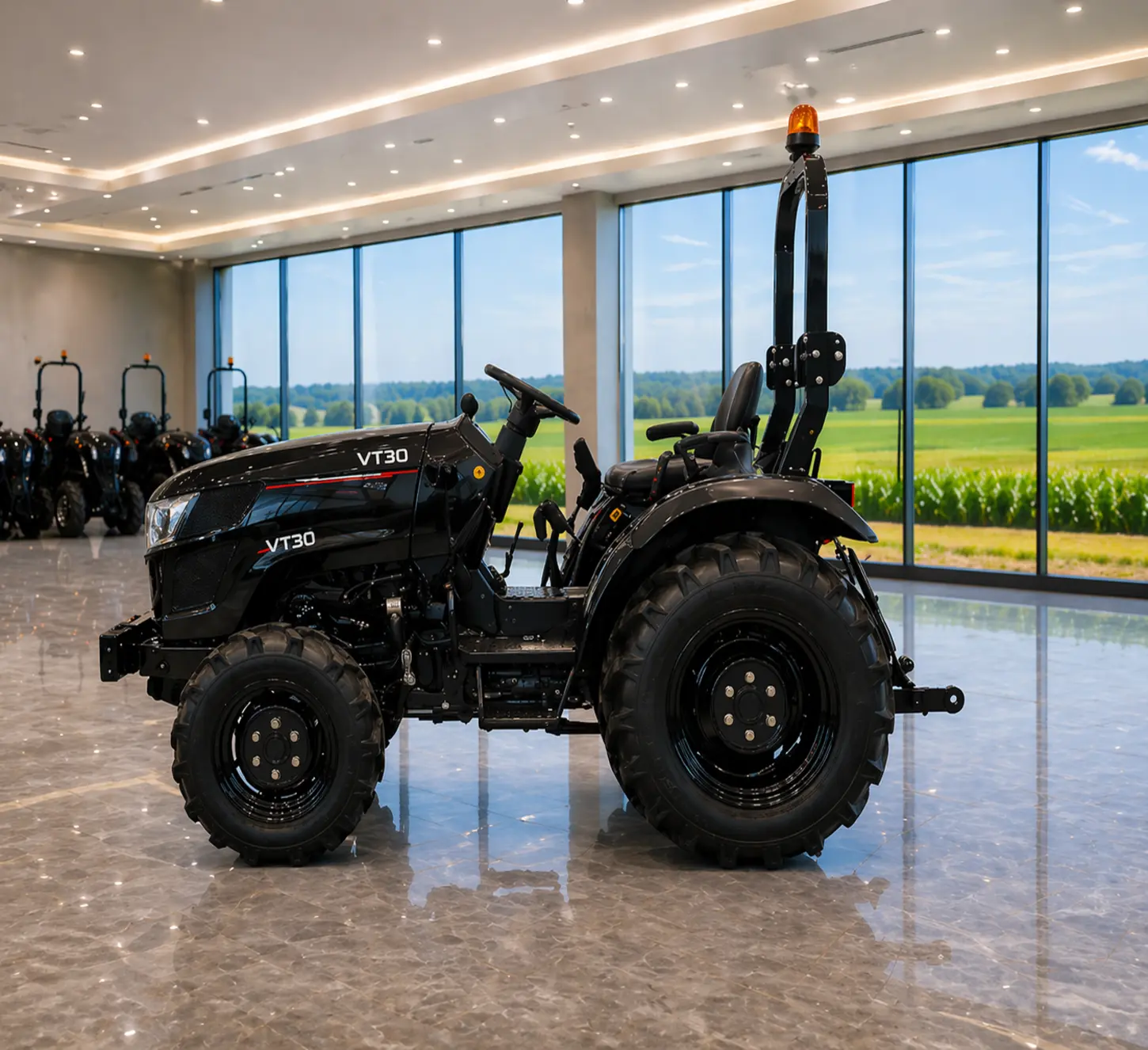
The VT 30 Stage V compact specialty tractor has been developed for European agricultural applications such as vineyards, orchards, horticulture, greenhouse operations, specialty crops and estate management.
It is powered by a 26 HP, three-cylinder Mitsubishi diesel engine and uses a 9-forward and 3-reverse constant-mesh transmission Permanent four-wheel drive supports traction across varied ground conditions.
The tractor also provides:
- 800 kg hydraulic lifting capacity
- Category I three-point linkage
- 540 and 540E PTO speeds
- Hydraulic power steering
- ROPS cab
- Safety switches
- Speed range from 1.42 to 22.85 km/h
These specifications allow the tractor to support suitable sprayers, inter-row cultivators and other vineyard, orchard and specialty-farming implements, subject to the attachment manufacturer’s weight and power requirements.
Its compact design is intended for operations where access, row width and turning space are important considerations.
Is the VT 30 Stage V Right for Your Farm?
The VT 30 Stage V may be worth considering when your work involves narrow crop rows, limited operating space or a mixture of PTO and hydraulic tasks.
Before requesting a quotation, prepare the following information:
- Country of use
- Farm size and terrain
- Vineyard or orchard row width
- Main agricultural applications
- Required implements
- Preferred working speeds
- Local approval or registration requirements
- Quantity required and delivery destination
Providing these details helps the machinery supplier recommend the correct tractor configuration and confirm whether your intended implements are suitable.
Frequently Asked Questions
Is a Stage V compact tractor suitable for vineyards?
Yes. A compact design can make it easier to work between vineyard rows, provided the tractor’s dimensions suit the plantation’s row spacing and turning areas.
Can a compact tractor be used in orchards?
Yes. Compact tractors can support mowing, spraying, inter-row cultivation and material movement in orchards when fitted with compatible implements.
Is 26 HP enough for a compact tractor?
Does Stage V apply across Europe?
What should I check before importing a tractor?
Confirm engine and tractor documentation, type approval, local registration rules, warranty support, spare-parts availability, delivery terms and implement compatibility.
Request a Machinery Quote
Looking for a Stage V compact tractor for vineyards, orchards, horticulture or specialty farming in Europe?
Explore the VT 30 Stage V or share your country, application, row width, required implements and order quantity with VHM Industries.
Contact Our Machinery Export Team to discuss specifications, export requirements and a quotation for your European market.